.png)


Pico Laser Tattoo Removal: How Does It Compare to Q-Switched Laser?

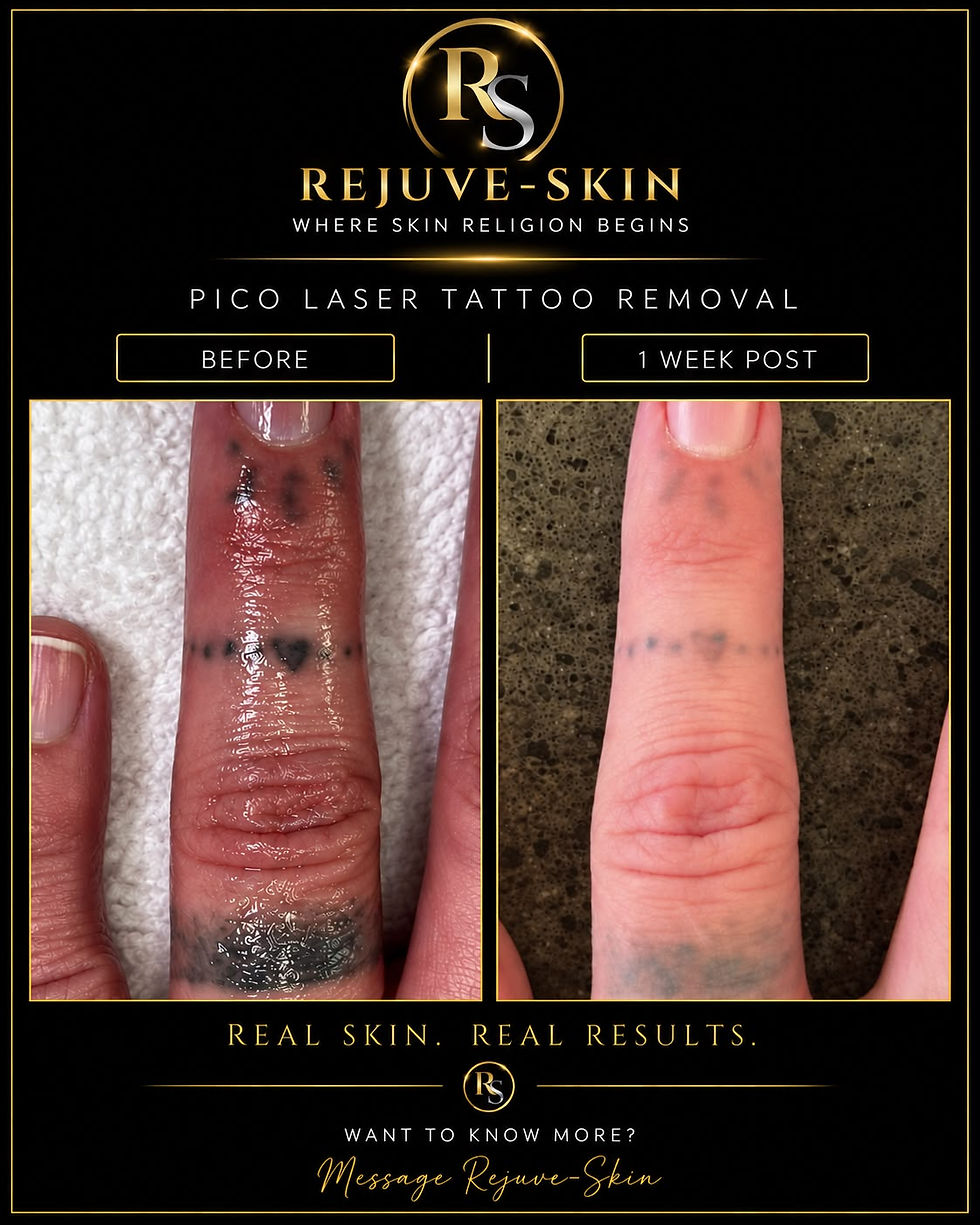
Pico vs Q-switched tattoo removal explained, including how picosecond technology works, wavelengths, tattoo colours, treatment sessions and why not every tattoo responds the same way.
If you’ve looked into laser tattoo removal, you’ve probably heard terms such as Pico laser, Q-switched laser, nanoseconds, picoseconds and wavelengths.
It can all sound unnecessarily complicated.
The basic principle of laser tattoo removal is actually quite simple: the laser doesn’t remove the tattoo, your body does.
The laser’s job is to break tattoo pigment into smaller particles so your body can gradually process and clear them.
30-Second Answer: Pico Laser vs Q-Switched Laser
What is the difference between Pico laser and traditional Q-switched laser tattoo removal?
The main difference is pulse duration.
Traditional Q-switched tattoo-removal lasers deliver energy in nanoseconds (billionths of a second), while true picosecond lasers deliver energy in picoseconds (trillionths of a second).
Rejuve-Skin’s Pico laser operates at approximately 750 picoseconds (750 ps).
This extremely short pulse creates a strong photoacoustic or photomechanical effect, breaking tattoo pigment into smaller fragments while reducing the amount of time heat has to spread into surrounding tissue.
However, successful tattoo removal depends on much more than whether a laser is labelled “Pico”.
Wavelength, ink colour, pigment density, skin type, tattoo depth, treatment parameters and practitioner experience all matter.
How Does Laser Tattoo Removal Work?
Tattoo ink sits within the skin in particles that are too large for the body to easily remove.
During laser tattoo removal, extremely short pulses of laser energy are directed into the tattoo. The tattoo pigment absorbs that energy, creating a rapid mechanical and thermal reaction that breaks the pigment into smaller fragments.
Your immune system then gets to work.
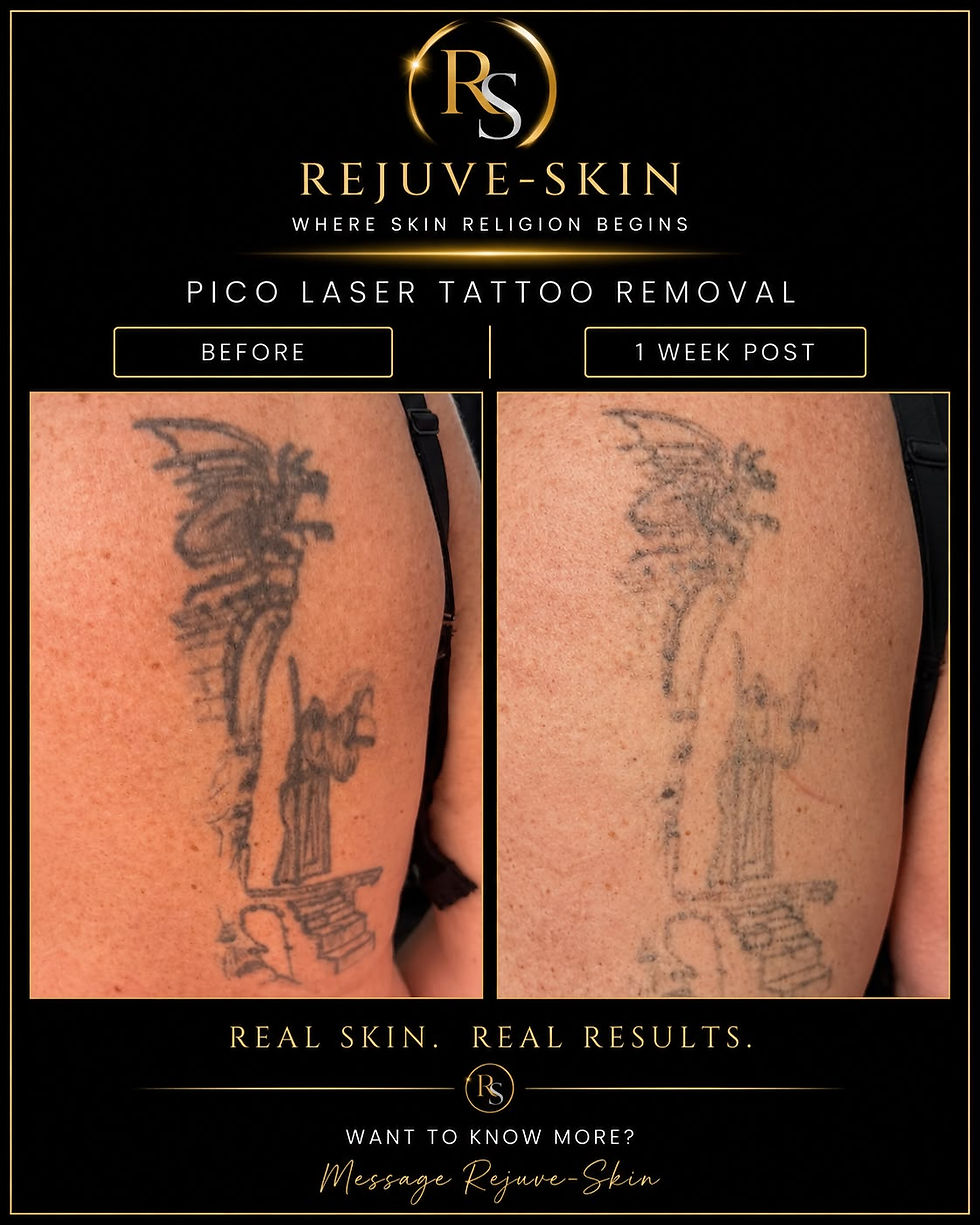
Over the following weeks, the body gradually processes and clears some of these fragmented pigment particles. This is why a tattoo continues to fade after the laser treatment has finished.
It is also why tattoo removal requires patience. Treating the tattoo again immediately would not make the process happen faster, the skin needs time to heal and the body needs time to do its part.
Why Are Multiple Laser Tattoo Removal Treatments Needed?
A tattoo isn’t simply a flat layer of ink sitting beneath the surface.
Pigment can be present at different depths and concentrations, and tattoos vary enormously depending on the ink used, the tattoo artist, how densely the pigment was placed, the age of the tattoo and whether it has been tattooed over.
Each laser session targets part of that pigment load.
As the tattoo becomes lighter, subsequent treatments continue breaking down the remaining pigment.
This is why no reputable practitioner should promise exactly how many laser tattoo removal treatments a tattoo will require before assessing it and seeing how it responds.
What Is Traditional Q-Switched Laser Tattoo Removal?
Q-switched lasers have been successfully used for tattoo removal for decades.
These lasers deliver energy in nanoseconds - AKA - billionths of a second.
That may already sound incredibly fast, and it is.
The short pulse creates enough energy to disrupt tattoo pigment while attempting to minimise damage to the surrounding skin.
Different Q-switched lasers and wavelengths are used depending on the pigment being targeted. Common systems include Nd:YAG, Alexandrite and Ruby lasers.
Q-switched technology remains effective, particularly for many black and dark tattoos.
So why did Pico lasers come along?
What Is Pico Laser Tattoo Removal?
Pico lasers make pulse duration considerably shorter.
Instead of delivering energy in nanoseconds, a true picosecond laser delivers its pulse in trillionths of a second.
Our Rejuve-Skin Pico laser operates at approximately 750 picoseconds (750 ps).
This extremely short pulse changes how energy interacts with tattoo pigment.
With traditional nanosecond technology, more thermal energy is involved in disrupting the pigment.
Picosecond technology produces a stronger photoacoustic, or photomechanical, effect —essentially an extremely rapid pressure effect that fractures the pigment.
Think of the difference as breaking a rock into smaller stones versus smashing those stones into much finer pieces.
The body's natural clearance mechanisms can then process the smaller fragments.
Does Pico Laser Tattoo Removal Use Less Heat?
This needs a little clarification.
Pico lasers still deliver energy, and heat is still produced. They are not heat-free treatments.
However, because the energy is delivered over such an incredibly short period, there is less time for heat to spread into the surrounding tissue.
That is one of the major advantages of very short pulse durations. Our goal isn’t simply to put more energy into the skin.
It is to deliver the right energy, at the right wavelength, over the right pulse duration, to the intended target while protecting the surrounding tissue as much as possible.
Can Pico Laser Remove Different Tattoo Colours?
Pico does not automatically mean every tattoo colour can be removed.
The laser wavelength is extremely important because different pigments absorb different wavelengths of light.
At Rejuve-Skin, our Pico platform includes 1064 nm and 532 nm wavelengths.
1064 nm is particularly important for black and other dark tattoo pigments, while 532 nm is commonly used for red and certain warmer-coloured pigments.
Some greens, turquoise shades, light blues and other unusual pigments may respond better to different wavelengths.
So when you see advertising suggesting that simply owning a “Pico laser” means a clinic can remove every tattoo colour, it isn’t quite that simple.
Pulse duration matters. Wavelength matters. The ink matters. And the person operating the laser matters.
Why Do Some Tattoos Remove More Easily Than Others?
Two tattoos that look almost identical can respond completely differently to laser tattoo removal.
Factors that can influence tattoo removal include:
Ink colour and composition
Amount and density of pigment
Depth of the tattoo
Professional versus amateur application
Age of the tattoo
Previous laser treatments
Tattoo layering or cover-ups
Skin type
Location on the body
Individual immune response
Black is generally one of the most responsive tattoo colours because it strongly absorbs commonly used tattoo-removal wavelengths.
Dense professional tattoos and cover-ups can take considerably longer because there may simply be much more pigment for the body to process.
Pico Laser vs Q-Switched Laser: Which Is Better for Tattoo Removal?
Pico technology represents a significant advancement in tattoo removal, but we don’t believe in pretending that older technology suddenly stopped working.
It didn’t.
Q-switched lasers have successfully removed tattoos for many years and remain effective technology.
The advantage of Pico is how quickly the energy is delivered.
Its ultra-short pulse duration can produce greater photomechanical fragmentation of tattoo pigment while limiting unnecessary thermal diffusion into surrounding tissue.
Depending on the tattoo, this may mean more efficient fading and potentially fewer treatments.
But there is no responsible way to promise that every Pico-treated tattoo will disappear in a particular number of sessions.
Tattoo removal is biology as much as it is technology.
What Happens After Pico Laser Tattoo Removal?
Immediately after treatment, the tattoo may develop a temporary white or frosted appearance. Redness, swelling, warmth and pinpoint bleeding can also occur depending on the tattoo and treatment parameters.
The visible laser treatment itself is only the beginning.
Over the following weeks, your body’s immune and lymphatic processes gradually deal with the fragmented pigment.
This is why we allow adequate healing and clearance time between treatments rather than repeatedly treating the skin simply because the tattoo is still visible.
More laser isn’t necessarily better laser.
Why Does the Tattoo Removal Practitioner Matter?
A powerful laser is only a tool. Successful tattoo removal also requires understanding wavelength, pulse duration, spot size, energy, fluence, skin type, tattoo characteristics, clinical endpoints and tissue response.
At Rejuve-Skin, we assess each tattoo individually rather than applying exactly the same treatment to every person.
Some tattoos respond beautifully.
Some take considerably longer.
Some colours are difficult.
And occasionally, complete removal may not be achievable.
We would rather explain that honestly at consultation than make promises a laser, Pico or otherwise, cannot guarantee.
Pico Laser Tattoo Removal FAQs
Is Pico laser better than Q-switched laser for tattoo removal?
Pico lasers deliver energy in picoseconds rather than the nanosecond pulses used by traditional Q-switched lasers. The shorter pulse can create greater photomechanical fragmentation of tattoo pigment while reducing the time available for heat to spread into surrounding tissue. However, the best approach depends on the tattoo, pigment colours, available wavelengths, skin type and treatment parameters.
How many Pico laser sessions does it take to remove a tattoo?
There is no reliable number that applies to every tattoo. Treatment requirements can vary according to ink colour, pigment density, tattoo depth, age, location, layering, previous treatments and individual biological response. A consultation and the tattoo’s response to initial treatments provide a much better indication.
Can Pico laser completely remove a tattoo?
Some tattoos can achieve significant clearance, but complete removal cannot be guaranteed. Certain colours, inks, deeply placed pigments and heavily layered or cover-up tattoos can be more difficult to treat.
Can Pico laser remove black tattoos?
Black is generally one of the more responsive tattoo colours because it absorbs commonly used tattoo-removal wavelengths well. Rejuve-Skin’s Pico platform includes a 1064 nm wavelength, which is particularly important for targeting black and other dark pigments.
Can Pico laser remove coloured tattoos?
Some colours can be targeted, but no single wavelength is ideal for every tattoo pigment. Rejuve-Skin’s platform includes 1064 nm and 532 nm wavelengths. Some greens, turquoise shades, light blues and unusual pigments may respond better to other wavelengths.
Is Pico laser tattoo removal heat-free?
No. Pico lasers still deliver energy and produce heat. Their extremely short pulse duration means there is less time for heat to spread into surrounding tissue compared with longer pulse durations.
Why does my tattoo keep fading after laser treatment?
Laser treatment fragments tattoo pigment, but your body performs much of the subsequent clearance. Immune and lymphatic processes continue dealing with fragmented pigment over the following weeks, which is why fading can continue after the laser session.
Why can't tattoo removal treatments be performed closer together?
Laser treatment is only one part of the removal process. The skin needs adequate time to heal, while the body needs time to process fragmented pigment. Treating visible pigment again too quickly does not necessarily make tattoo removal happen faster.
Does a Pico laser remove every tattoo colour?
No. “Pico” describes the extremely short duration of the laser pulse; it does not mean every wavelength is available. Different tattoo pigments respond to different wavelengths, which is why both the laser technology and its available wavelengths matter.
What should I look for when choosing a laser tattoo removal clinic?
Look beyond the word “Pico”. Ask about the laser’s actual pulse duration, available wavelengths, the practitioner’s experience, how your skin and tattoo will be assessed and whether realistic expectations are discussed before treatment.
Considering Pico Laser Tattoo Removal?
Every tattoo is different.
A consultation allows us to assess your tattoo, discuss its colours and pigment density, explain what our 750 ps Pico laser with 1064 nm and 532 nm wavelengths can realistically target, and develop an individual treatment plan.
Rejuve-Skin Advanced Skin & Laser Technology
Where Skin Religion Begins


Comments